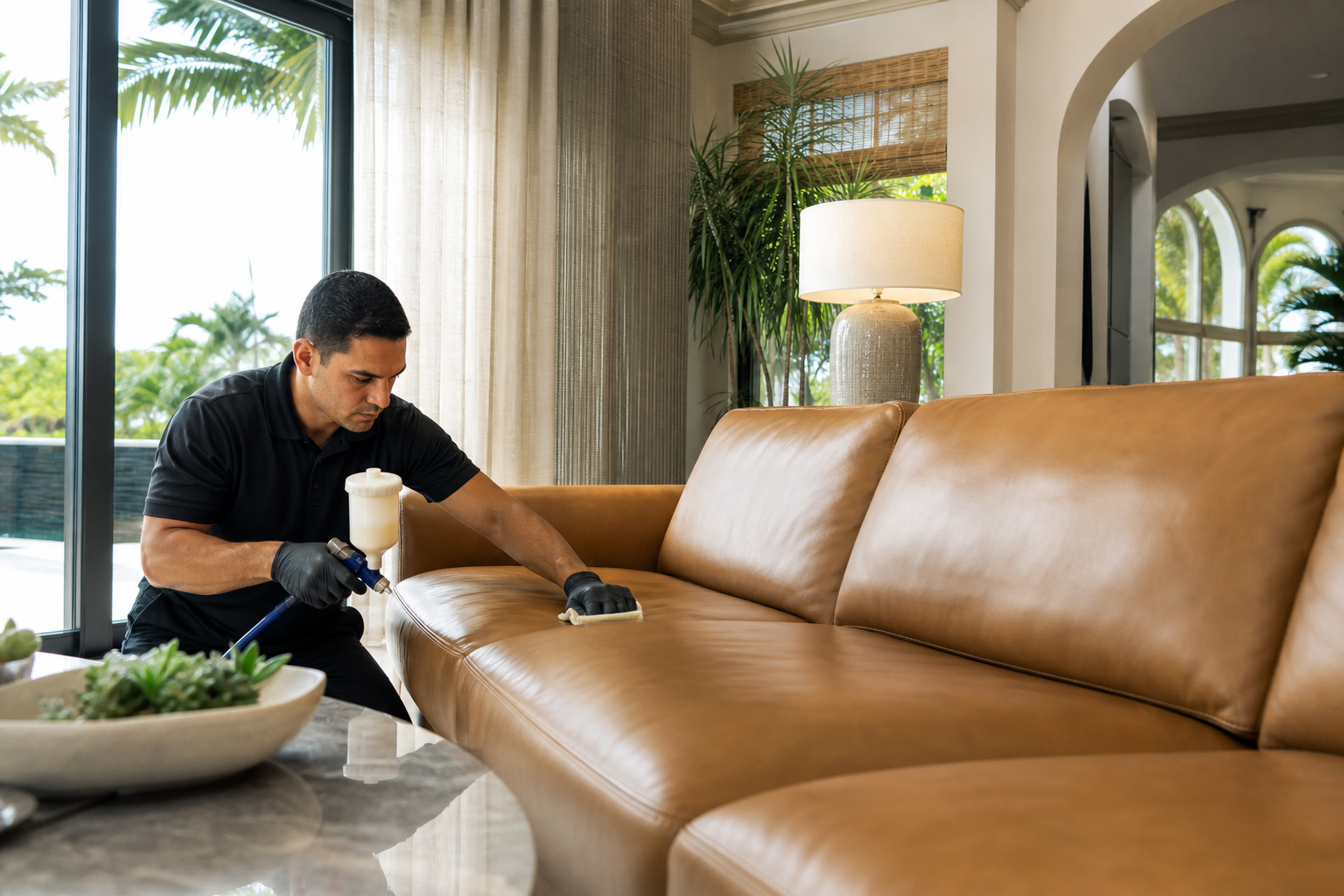
Protective topcoats are an important part of professional leather finishing, but they are often misunderstood. A topcoat is not the same as a leather conditioner, cleaning product, or general-purpose protectant. It is a finish applied over the leather’s surface—or over a restored color layer—to help improve resistance to everyday wear, handling, moisture, and staining.
For homeowners, vehicle owners, boat owners, and businesses in Southwest Florida, the right topcoat can support a longer-lasting leather restoration or color repair. However, the finish must be compatible with the leather type, existing coating, color, sheen, and intended use. Applying the wrong product can create an uneven appearance, unwanted gloss, stiffness, tackiness, or adhesion problems.
This guide explains what protective topcoats do, when they are appropriate, and how professional leather care can help protect valuable furnishings and interiors in Fort Myers, Naples, Cape Coral, and surrounding communities.
What Is a Protective Topcoat for Leather?
A protective topcoat is a clear or lightly tinted finishing layer applied to the surface of leather. In many professional restoration systems, it is used after cleaning, preparation, color restoration, or redye work. Once properly cured, the topcoat becomes part of the finished surface rather than sitting on the leather like a heavy layer of polish.
Depending on the system and the leather application, a topcoat may help:
- Reduce friction from regular contact and use
- Improve resistance to body oils, soil, and everyday handling
- Help preserve a newly restored color
- Create a consistent matte, satin, or gloss appearance
- Support easier routine cleaning
- Provide an additional barrier against some surface-level spills and contaminants
A topcoat does not make leather indestructible or permanently waterproof. It also cannot correct structural damage, deep staining, cracking, poor color adhesion, or incorrect preparation underneath. Its performance depends on the leather’s condition, the quality of the application, and the way the item is used and maintained.
How Topcoats Differ from Leather Conditioners and Protectors
Leather care products are designed for different purposes, and confusing them can lead to disappointing results.
Leather conditioner
A conditioner is intended to support the feel and flexibility of suitable leather. It may help replace some of the oils or emollients that can be lost through age and use. Conditioning does not create the same type of cured surface finish as a professional topcoat, and not every leather benefits from frequent conditioning.
Leather protector
A protector is generally used to help reduce the absorption or adhesion of certain soils and spills. Protectors vary widely by leather type and product chemistry. They are not always appropriate for heavily finished, delicate, suede-like, or specialty leathers.
Protective topcoat
A topcoat is a finishing layer that is applied as part of a controlled leather finishing process. It is especially relevant after leather repair, color restoration, or redye work, when the new surface needs a compatible final finish.
Cleaning and conditioning should not be treated as interchangeable steps. For a broader explanation, see why leather cleaning and conditioning are two different steps.
Which Leather Can Receive a Protective Topcoat?
The answer depends on the leather’s surface and existing finish. Many pigmented or protected leathers have a factory-applied coating that can be cleaned and, when necessary, professionally refinished. These include many leather sofas, vehicle seats, office chairs, restaurant seating, yacht interiors, and aircraft seats.
Some aniline, semi-aniline, nubuck, suede, pull-up, waxed, or specialty leathers require a different approach. Their appearance and feel may depend on an open or semi-open surface, and a conventional topcoat could alter the character of the material. A product that works well on a coated automotive seat may be unsuitable for a soft, absorbent designer handbag or an unfinished leather panel.
Before a topcoat is selected, a professional should assess:
- Leather type and surface finish
- Whether the existing coating is intact, worn, peeling, or contaminated
- Current color and sheen
- Previous repairs, dyes, conditioners, or household products
- Level of use and friction
- Exposure to sunlight, heat, humidity, salt, sunscreen, and body oils
Understanding the difference between protected and more absorbent leathers is essential. Our guide to pigmented or protected leather provides additional background on one of the most common finished leather types.
When Does Leather Need a Protective Topcoat?
A topcoat may be appropriate when leather has been professionally recolored, repaired, or restored. It can also be considered when the existing finish has become thin or inconsistent from years of contact and cleaning. Common situations include:
After leather redye or color restoration
New color needs a compatible finishing system to help it bond appropriately and present a consistent sheen. Skipping the finishing stage can leave the surface more vulnerable to rubbing, transfer, and premature wear.
After certain leather repairs
When a repair includes a filled area, refinished section, or blended color, a topcoat may help unify the repaired area with the surrounding leather. The goal is not simply to cover the repair, but to create a natural transition in color and texture.
When high-contact areas show finish wear
Driver bolsters, armrests, steering wheels, dining chairs, desk chairs, and sofa cushions often experience repeated friction. If the original coating is wearing away but the leather underneath remains suitable for restoration, a professional may recommend refinishing and topcoat application.
When a commercial or marine interior needs a planned finish system
Leather in medical offices, hospitality settings, boats, and other commercial environments may experience frequent cleaning and heavy use. A properly selected finish can be part of a broader maintenance plan, but it should not be used to compensate for unsuitable cleaning methods or neglected damage.
Why Southwest Florida Conditions Matter
Leather in Southwest Florida faces a combination of environmental and lifestyle factors that can accelerate surface wear. Strong sunlight can contribute to fading and finish deterioration, particularly near windows, in convertibles, and in vehicles that are regularly parked outdoors. Heat can make surfaces feel warmer and may increase the transfer of body oils and sunscreen.
High humidity can affect drying conditions and may contribute to odor or mildew concerns when leather is exposed to moisture and does not dry properly. Boats and waterfront properties may also expose leather to salt residue, spray, damp air, and wet clothing. Seasonal homes can have another challenge: leather may sit unused for extended periods in closed rooms or vehicles before owners return.
A protective topcoat may support the finished surface, but it does not eliminate the need for practical care. Leather should still be cleaned with products appropriate for its finish, kept away from unnecessary direct sunlight when possible, and allowed to dry properly after moisture exposure. Sunscreen and suntan lotion are especially relevant in Florida; safe sunscreen removal from leather is preferable to aggressive scrubbing that can damage the finish.
How Professionals Select the Right Topcoat
Choosing a topcoat is not simply a matter of selecting the strongest available product. The finish should be matched to the leather and the intended result.
Surface appearance
The correct finish should complement the original look. A high-gloss coating on a naturally matte sofa may look artificial, while a dull finish on a polished automotive interior may appear inconsistent. Professionals may adjust the finish level to blend with adjacent panels or preserve the character of the original leather.
Flexibility and use
Leather bends, stretches, and flexes. Seating, vehicle bolsters, marine cushions, and aircraft interiors require a finish that can accommodate normal movement. A rigid or poorly bonded coating may crack, peel, or feel unnatural as the leather is used.
Compatibility
Any existing coating, colorant, repair material, cleaner residue, or conditioner can affect adhesion. Proper preparation may include cleaning, degreasing, controlled abrasion, testing, and removal of unstable material. A professional should test an inconspicuous area before proceeding across a visible surface.
Maintenance requirements
Some finished surfaces are easier to maintain when they are cleaned regularly with a compatible leather cleaner. The owner should understand what products to avoid after application. Household cleaners, disinfectants, alcohol-based products, and abrasive wipes may affect the finish. Learn more about why household cleaners can damage leather.
What to Ask Before Buying or Requesting a Topcoat Service
If you are comparing leather care providers or considering a protective topcoat for a valuable item, ask practical questions before work begins:
- What type of leather and existing finish does the item have?
- Is the topcoat intended for routine maintenance, restoration, or color work?
- What preparation is required before application?
- What sheen will the finished surface have?
- Will the process affect the leather’s hand, softness, or appearance?
- How should the leather be cleaned after treatment?
- Are there areas that need repair or color restoration before a topcoat can be applied?
- Will the service be performed on-site or in a controlled workshop environment?
Be cautious of a one-size-fits-all approach. Leather types, finishes, colors, and usage conditions vary considerably. A thoughtful assessment is more valuable than a broad promise that one coating will solve every leather problem.
Can You Apply a Leather Topcoat Yourself?
Some consumer products are marketed as leather sealers or protectants, but do-it-yourself application carries risks. The surface may not be clean enough for proper bonding, or the product may be incompatible with the existing finish. Uneven spraying or wiping can produce streaks, cloudy areas, gloss differences, overspray, or visible overlap lines.
DIY application is especially risky on luxury furniture, exotic or specialty leather, automotive interiors, yachts, aircraft, and items with sentimental or replacement value. If the leather already has peeling, cracking, fading, sticky residue, water damage, or discoloration, applying a coating before diagnosis may lock in the problem or make later restoration more difficult.
Professional application does not replace sound maintenance. It is one step in a complete process that may include inspection, cleaning, repair, color restoration, finishing, and owner guidance.
How to Care for Leather After a Topcoat Is Applied
- Follow the care instructions provided for the specific leather and finish.
- Remove dust and loose soil regularly with a soft, clean cloth or suitable vacuum attachment.
- Blot spills promptly instead of rubbing them across the surface.
- Use only a cleaner confirmed to be appropriate for the leather finish.
- Keep leather away from unnecessary direct sunlight and excessive heat where practical.
- Do not use household disinfectants, harsh degreasers, abrasive pads, or unapproved wipes.
- Arrange professional evaluation if the surface becomes sticky, dull, cracked, peeling, or uneven.
A topcoat can help preserve a finished surface, but it cannot prevent all damage. Repeated friction, sharp objects, pet claws, dye transfer, standing moisture, and improper cleaning can still affect leather.
Frequently Asked Questions
Is a protective topcoat the same as waterproofing?
No. A topcoat may improve resistance to some surface-level moisture and contamination, but it does not make leather fully waterproof. Water can still enter through seams, perforations, damaged areas, stitching, or worn sections.
Will a topcoat make leather shiny?
Not necessarily. The final appearance depends on the selected finish and the leather’s original sheen. A professional should aim for a finish that looks appropriate for the item rather than automatically creating a glossy surface.
Can every leather sofa receive a topcoat?
No. Many protected leather sofas may be suitable, but aniline, suede, nubuck, waxed, pull-up, and other specialty leathers require individual assessment. Applying the wrong coating can change the look and feel of the material.
Does leather need to be cleaned before topcoat application?
Yes, preparation is normally essential. Dirt, body oils, silicone residue, old products, and unstable finish material can interfere with adhesion and appearance. The specific preparation depends on the condition and leather type.
How often should a leather topcoat be reapplied?
There is no universal schedule. Reapplication depends on use, exposure, cleaning habits, the condition of the original finish, and whether the leather has undergone repair or color restoration. A professional inspection is more reliable than applying a coating on a fixed calendar.
Professional Leather Finishing in Southwest Florida
Protective topcoats are most effective when they are part of a carefully planned leather care or restoration process. Luxury Leather evaluates the leather type, current finish, damage, use, and environment before recommending an approach for residential, automotive, marine, aviation, and commercial applications.
Whether you are preserving a leather sectional in Naples, restoring vehicle seats in Fort Myers, maintaining boat cushions near Cape Coral, or caring for high-use seating in a Southwest Florida business, proper preparation and finish selection matter. Contact Luxury Leather for a free consultation to discuss the right care, protection, or restoration plan for your leather.