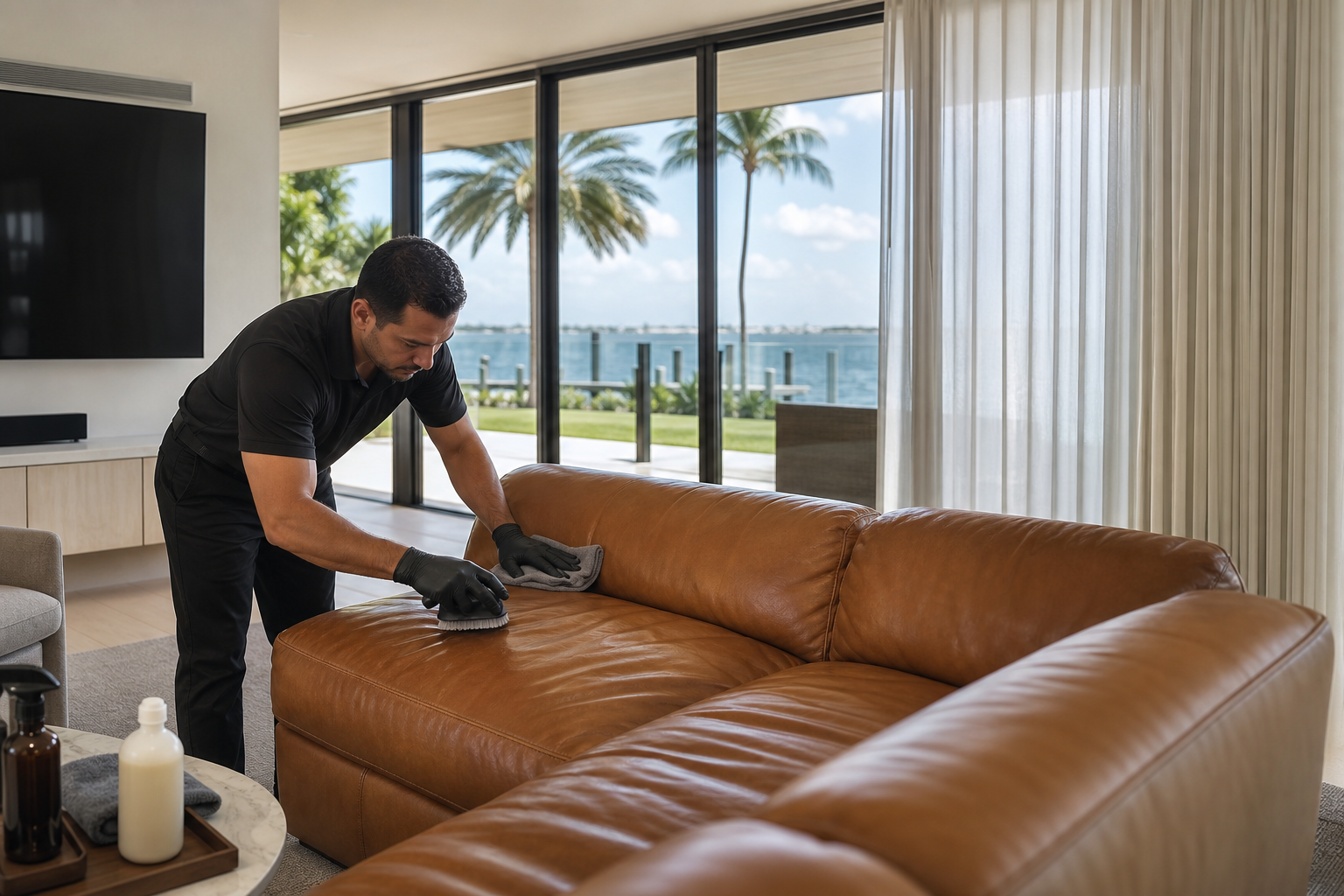
Professional leather cleaning is often misunderstood as a simple wipe-down. In reality, a careful cleaning service is designed to identify and remove accumulated contamination without unnecessarily disturbing the leather’s finish, color, texture, or natural character.
That distinction matters in Southwest Florida, where leather furniture, vehicle interiors, boats, aircraft, and commercial seating may be exposed to intense sunlight, humidity, sunscreen, salt air, body oils, dust, food residue, and seasonal-home conditions. Over time, these contaminants can create a dull, sticky, darkened, or uneven appearance.
So, what is actually removed during a professional leather cleaning? The answer depends on the leather type, finish, age, condition, and the nature of the contamination. A professional assessment helps determine what can be safely removed through cleaning and what requires conditioning, protection, repair, color restoration, or another specialized service.
What Professional Leather Cleaning Is Designed to Remove
A professional leather cleaning typically focuses on removable surface contamination and buildup. The goal is not to strip the leather or make every sign of age disappear. It is to clean the material carefully while preserving its intended appearance and finish.
Surface dust and airborne particles
Dust settles into seams, stitching, piping, perforations, creases, and textured grain. In Southwest Florida, open windows, HVAC systems, construction activity, and seasonal weather can contribute to repeated dust accumulation.
Loose dust may seem harmless, but it can combine with oils and moisture to form a film that is more difficult to remove. Professional cleaning begins with methods appropriate for the leather and its construction, helping address contamination in areas that routine dusting may miss.
Body oils and perspiration
Leather frequently contacts skin, hair, hands, arms, and clothing. Body oils and perspiration can gradually collect on high-contact areas such as steering wheels, armrests, seat bolsters, headrests, sofa cushions, and office chair arms.
This buildup may leave leather looking darker, shiny, greasy, or uneven. It can also make the surface feel tacky. Professional cleaning is intended to lift removable oils from the surface while avoiding excessive moisture or aggressive rubbing that could affect the finish.
Sunscreen and suntan lotion residue
Sunscreen is especially relevant in Florida homes, vehicles, boats, and outdoor-oriented environments. Lotion transferred from skin to leather can create a hazy, oily, or sticky area. Repeated contact may also attract dust and cause a visible difference between frequently used areas and protected sections.
Professional cleaning can address removable sunscreen residue, although the outcome depends on how long the product has been present and whether it has altered the finish or color. For related guidance, see Sunscreen and Suntan Lotion on Leather: Safe Removal Tips.
Food and beverage residue
Crumbs, drink residue, grease, and spills can settle into seams and textured surfaces. Even when a spill appears to have been wiped up, a residue may remain and attract additional dirt.
Professional cleaning may remove surface residue from coffee, soft drinks, food oils, and similar contaminants. However, a stain that has penetrated the finish, backing, foam, or underlying structure may require more than standard cleaning.
Everyday grime and transfer marks
Leather can collect dye transfer from clothing, dirt from hands, makeup, shoe contact, bag straps, and other sources. Common examples include darkened seat bolsters, hand marks on a steering wheel, and gray or brown buildup on frequently touched furniture.
Some transfer marks are removable contamination. Others may have chemically interacted with the finish or caused permanent color change. A professional cleaner evaluates the difference before selecting a treatment.
Light adhesive and product residue
Leather may occasionally come into contact with tape residue, labels, cosmetics, hair products, or other substances. These materials should not automatically be scrubbed or treated with household solvents. The wrong product can soften, dull, discolor, or remove the protective finish.
Professional cleaning can sometimes reduce or remove light residue, but the method must be selected according to the leather’s finish and the substance involved.
What Cleaning Does Not Automatically Remove
Cleaning is an important part of leather care, but it is not the same as restoration. Some changes are not surface contamination and cannot be safely corrected through cleaning alone.
Permanent dye transfer or discoloration
Dark clothing, denim, bags, and other materials can transfer color to leather. If the transfer is recent and remains on the surface, some of it may be reduced through careful cleaning. If the color has penetrated or affected the finish, cleaning may not fully reverse it.
In those cases, color correction or leather redye work may be more appropriate than repeated cleaning.
Cracks, peeling, and finish failure
Dryness, wear, heat, friction, age, and previous products can contribute to cracking or peeling. Cleaning cannot rebuild missing leather fibers or replace a deteriorated coating. Applying more cleaner or scrubbing harder may make the damage more visible.
Leather that is cracked, peeling, or heavily worn may need repair, restoration, or color refinishing after the surface has been properly assessed.
Deep odors
A surface cleaning may reduce odor-causing residue, but odors can remain when contamination has entered foam, backing, seams, or other internal materials. Pet accidents, smoke, mildew, and prolonged moisture exposure may require a specialized treatment plan.
For pet-related contamination, the material involved and the depth of the contamination are important. Cleaning the visible surface does not necessarily address every source of odor.
Mold and mildew damage
Humidity and moisture can create conditions where mold or mildew develops on or around leather. Professional cleaning may remove visible surface contamination in appropriate circumstances, but the leather, backing, padding, and surrounding environment must be evaluated.
In Southwest Florida, seasonal homes, enclosed vehicles, boats, and storage areas may need particular attention to ventilation and moisture control. Cleaning alone is not a substitute for addressing the source of persistent dampness.
Sun fading and chemical damage
UV exposure can fade or change leather color, especially in vehicles, rooms with strong window exposure, boats, and aircraft. Sunscreen, household cleaners, alcohol-based products, and other chemicals may also affect the finish.
Once color has faded or the finish has been altered, cleaning may reveal the condition more clearly but will not necessarily restore the original color. Redye or color restoration may be considered after cleaning and evaluation.
Why the Leather Finish Matters
Not all leather responds to cleaning in the same way. Finished or protected leather generally has a surface coating that influences how oils, water, and dirt interact with the material. Aniline and other less-protected leathers may absorb substances more readily and require a more cautious approach.
Correct identification helps determine:
- How much moisture can be used safely
- Which cleaning methods are appropriate
- Whether a contamination is on the surface or has penetrated the leather
- How much agitation the finish can tolerate
- Whether conditioning or protection should follow cleaning
Leather may also be combined with vinyl, synthetic materials, fabric, wood, metal, or specialty trim. A professional assessment helps prevent treating every surface as if it were identical.
What Happens During a Professional Leather Cleaning?
Although the exact process varies by application, a responsible professional cleaning generally involves several stages.
- Inspection: The leather is examined for its finish, color, texture, wear, previous repairs, contamination, and areas of concern.
- Testing: A discreet area may be evaluated to help determine how the finish responds to the selected approach.
- Dry soil removal: Loose dust and debris are addressed before moisture-based cleaning begins.
- Controlled cleaning: Appropriate methods are used to lift oils, grime, and residue without excessive saturation or friction.
- Detailing: Seams, stitching, creases, piping, perforations, and other areas are addressed as appropriate for the material.
- Drying and review: The surface is allowed to dry appropriately and reviewed for remaining contamination or damage.
- Next-step recommendations: Conditioning, protection, repair, redye, or restoration may be recommended if cleaning alone will not address the issue.
This process is different from using a household wipe or multipurpose spray. Products intended for other surfaces may leave an oily film, dry the finish, create shine, or contribute to discoloration. Read more about why household cleaners can damage leather.
Cleaning Versus Conditioning and Protection
Professional leather cleaning removes contamination. Conditioning and protection serve different purposes and should not be treated as interchangeable steps.
Conditioning may be recommended when the leather’s condition and finish are compatible with it. Protection may help reduce the impact of future spills, oils, and everyday use, but it does not make leather maintenance-free. The correct sequence and products depend on the specific leather.
For a clearer explanation of these services, see why leather cleaning and conditioning are two different steps.
How Southwest Florida Conditions Affect Leather
Leather in Fort Myers, Cape Coral, Naples, Bonita Springs, Estero, Marco Island, Sanibel, Captiva, Port Charlotte, Punta Gorda, Lehigh Acres, and nearby communities may face conditions that accelerate visible buildup.
- Heat and UV exposure: Sunlight and elevated temperatures can affect color and surface finishes.
- Humidity: Moisture in the air may contribute to odor, mildew concerns, and a tacky feel in enclosed spaces.
- Salt air and water exposure: Coastal homes, vehicles, and marine interiors may collect salt residue and moisture.
- Sunscreen and body oils: Frequent outdoor activity can increase transfer onto seats, armrests, and other high-contact areas.
- Seasonal occupancy: Homes, boats, and vehicles that sit unused may develop dust, stale odors, or moisture-related concerns before they are noticed.
These factors make routine inspection and appropriate maintenance valuable, particularly for premium furniture, automotive interiors, yachts, boats, aircraft, and commercial seating.
When Should You Request Professional Leather Cleaning?
Consider professional service when leather has visible darkening, a sticky or greasy feel, uneven appearance, embedded grime, persistent residue, or contamination that has not responded to appropriate routine care. Professional attention is also sensible before applying a conditioner, protectant, or color product to heavily soiled leather.
If leather has cracking, peeling, fading, strong odor, mold concerns, pet contamination, or damage from an unknown household product, cleaning may be only the first step. A professional can help determine whether the material needs cleaning alone or a broader restoration plan.
Frequently Asked Questions
Does professional leather cleaning remove every stain?
No. Cleaning can remove or reduce many surface contaminants, but permanent dye transfer, sun fading, finish damage, deep odors, and penetrated stains may require repair, redye, restoration, or specialized treatment.
Will professional cleaning make old leather look new?
Cleaning can improve the appearance of removable dirt and residue, but it does not erase normal wear, patina, cracking, fading, or missing finish. The expected result depends on the leather’s age, condition, and history.
Is leather cleaning safe for furniture and car interiors?
The appropriate method depends on the leather type, finish, construction, and condition. Furniture, automotive interiors, marine seating, and aviation interiors may each have different cleaning requirements, which is why inspection matters.
Should leather be conditioned immediately after cleaning?
Not automatically. Conditioning is a separate step, and it should be recommended based on the leather and finish. Applying an unsuitable conditioner can leave residue or change the appearance.
Can professional cleaning remove sunscreen from leather?
It may remove removable sunscreen residue from the surface. Older or repeated buildup may have affected the finish or attracted additional contamination, so complete removal cannot be assumed without an assessment.
Choose Professional Leather Care in Southwest Florida
Professional leather cleaning is about more than making a surface look better temporarily. It is a careful process of identifying contamination, removing what can be safely lifted, and recognizing when the leather needs a different service.
Luxury Leather provides leather cleaning and related care for residential, automotive, marine, aviation, commercial, and medical-office applications throughout Southwest Florida. Contact us for a free consultation to discuss your leather’s condition and determine the most appropriate next step.