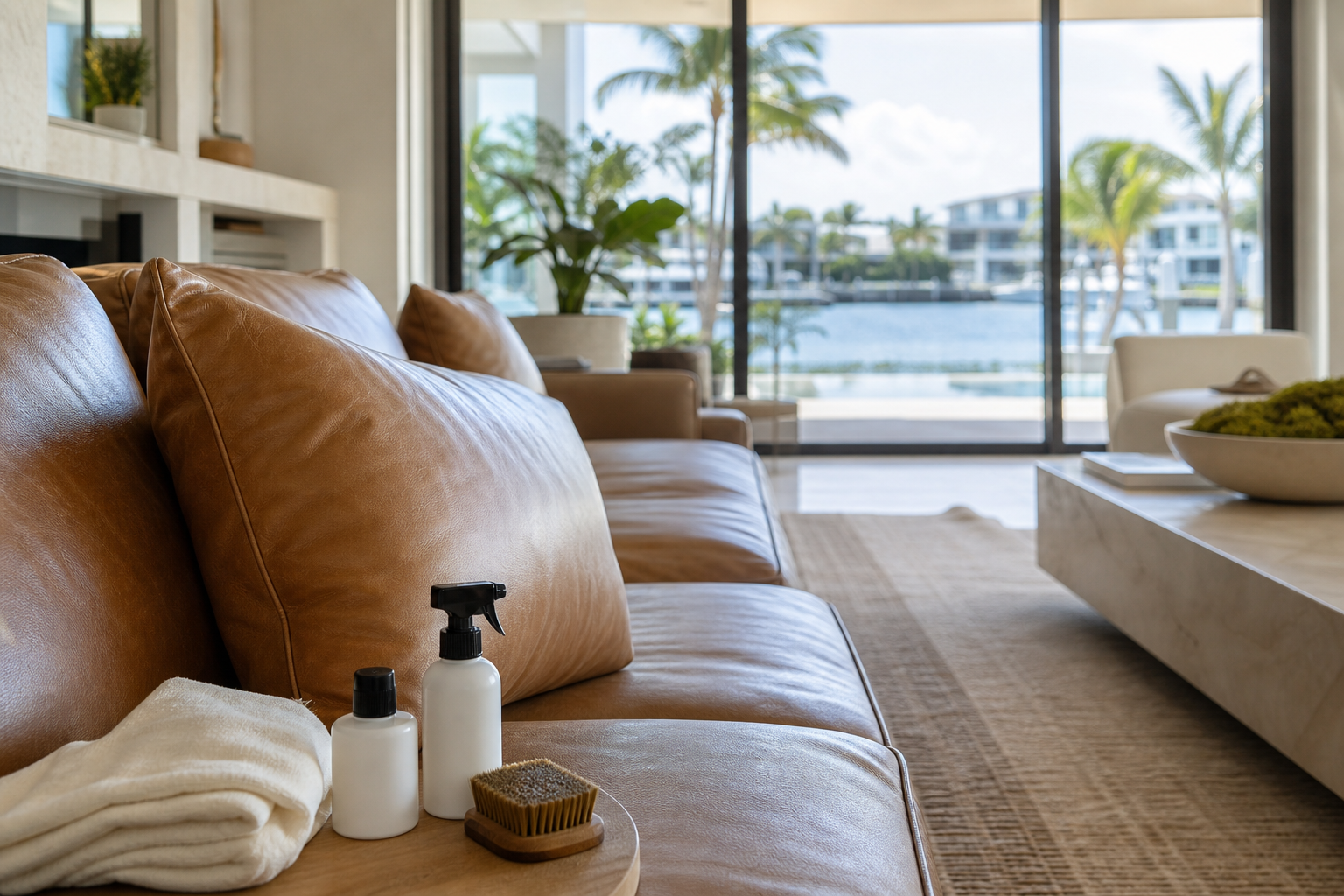
When a spill, sunscreen mark, or greasy fingerprint appears on a leather sofa or car seat, reaching for an all-purpose cleaner can feel like the simplest solution. It is already under the sink, it is designed to remove dirt, and the label may suggest that it works on many surfaces.
Leather, however, is not an ordinary hard surface. It is a finished natural material with a surface coating, color system, and structure that can react poorly to household cleaning products. Even when all-purpose cleaner removes visible dirt, it may also strip protective components, alter the finish, spread a stain, or leave leather dry and uneven.
For homeowners and businesses in Southwest Florida, careful leather care is especially important. Heat, strong sunlight, humidity, sunscreen, body oils, and frequent use can already place stress on leather. Using the wrong cleaner can accelerate surface damage that may eventually require professional leather cleaning, repair, or color restoration.
What Makes All-Purpose Cleaner Risky for Leather?
All-purpose cleaners are formulated for a broad range of nonporous household surfaces, such as countertops, sealed flooring, appliances, and other hard materials. Leather has a more complex surface. Depending on the item, it may include a pigment layer, protective topcoat, texture, oils, and a flexible fiber structure beneath the finish.
A cleaner that is suitable for tile or laminate may be too aggressive, too alkaline, too acidic, too wet, or too solvent-based for leather. The exact risk depends on the product, the leather type, the condition of the finish, and how long the cleaner remains on the surface.
Common problems associated with using all-purpose cleaner on leather include:
- Loss of surface sheen or an uneven appearance
- Color transfer, fading, or darkened areas
- Sticky or tacky residue that attracts more soil
- Dryness, stiffness, or premature cracking
- Damage to the protective finish
- Water rings or tide marks from excessive moisture
- Streaking that becomes more visible after drying
- Discoloration around seams, piping, and textured areas
Damage is not always immediate. A leather surface may look clean at first and then become dull, brittle, or uneven after repeated exposure.
Why Leather Needs a Specialized Cleaning Approach
Leather cleaning is not simply a matter of applying a stronger product. The correct process begins with identifying the leather and evaluating its finish. A protected or pigmented leather sofa, aniline leather chair, suede panel, coated automotive seat, and marine vinyl surface may all require different methods.
Leather can absorb or hold onto products
Some leather surfaces are more absorbent than others. If a cleaner penetrates beyond the surface finish, it may leave a darker area or create a mark that is difficult to remove. Even protected leather can hold residue in grain patterns, perforations, stitching, and creases.
The finish can be affected even when the leather underneath looks fine
Many leather items rely on a finish to provide color consistency, stain resistance, and a uniform appearance. Harsh or unsuitable products may dull, soften, or partially remove that finish. Once the finish is compromised, routine cleaning may no longer produce an even result.
Leather needs controlled moisture
Using too much liquid can cause uneven drying, water spots, or moisture-related changes in appearance. This is particularly important for furniture, vehicle interiors, boat seating, and leather items in humid Southwest Florida homes.
For a broader explanation of the risks, see Why Household Cleaners Can Damage Leather.
Common Ingredients That May Create Problems
Not every all-purpose cleaner contains the same ingredients, and the label alone may not reveal how a product will interact with a particular leather finish. Still, several categories deserve caution.
Strong detergents and degreasers
Products designed to cut through kitchen grease may remove more than surface soil. On leather, they can disturb the finish or remove components that help the material remain flexible. Repeated use may leave the surface looking dry or uneven.
Alcohols and solvents
Some household cleaners contain alcohols or solvents that can affect dyes, coatings, adhesives, or protective finishes. A small test spot may not always predict the full result, especially if the product is rubbed aggressively or used repeatedly.
Bleaching or oxidizing ingredients
Brightening agents may lighten or alter leather color. They can also create a noticeable contrast between the cleaned area and the surrounding surface.
Fragrances and additives
Fragrance does not make a cleaner safer for leather. Additives can leave residue, and residue may attract dust or create a sticky feel as it dries.
Excessive water
Even a relatively mild product can create problems if it is sprayed heavily onto leather. Saturation can lead to darkening, rings, swelling in some components, or slow drying in humid conditions.
What to Do If You Already Used All-Purpose Cleaner
If you have already applied all-purpose cleaner, avoid trying to correct the problem by adding more products. Layering cleaners can make the residue more difficult to identify and may increase the risk of finish damage.
- Stop rubbing. Aggressive scrubbing can spread the product and create a lighter or shinier area.
- Remove visible excess carefully. Use a clean, soft, lightly dampened cloth if appropriate for the leather surface. Do not saturate the material.
- Blot rather than scrub. Gentle blotting can lift surface moisture without grinding residue deeper into the grain.
- Allow the area to dry naturally. Keep the leather away from hair dryers, heaters, and direct intense sunlight.
- Document what happened. Keep the product container or take a photo of the label. This can help a leather professional understand what was applied.
- Arrange an evaluation if the appearance has changed. Streaking, tackiness, fading, stiffness, cracking, or a darkened patch may require professional cleaning or restoration.
Do not apply conditioner immediately just to make the surface look less dry. Conditioning over residue or a damaged finish can create additional buildup and may make later treatment more complicated.
Safer Leather Cleaning Habits at Home
Routine maintenance does not need to be complicated, but it should be gentle and consistent.
- Dust leather regularly with a clean, dry microfiber cloth.
- Address spills promptly by blotting with a soft cloth instead of wiping outward.
- Use products specifically intended for the identified leather type.
- Apply any cleaner to the cloth as directed rather than flooding the leather.
- Test in a concealed area and allow the test area to dry before proceeding.
- Avoid scrubbing grain, perforations, stitching, and seams.
- Keep leather away from prolonged direct sun and unnecessary heat.
- Follow cleaning with appropriate conditioning only when the leather and product instructions call for it.
Cleaning and conditioning are separate steps. Cleaning addresses soil and residue, while conditioning is intended to support the feel and flexibility of suitable leather surfaces. Using one product as a substitute for the other can produce disappointing results. Learn more in Why Leather Cleaning and Conditioning Are Two Different Steps.
Southwest Florida Considerations for Leather Care
Leather in Fort Myers, Cape Coral, Naples, Bonita Springs, Estero, Marco Island, Sanibel, Captiva, and surrounding communities may encounter conditions that make residue and finish damage more noticeable.
Heat and sunlight
Southwest Florida sun can contribute to fading and surface heating, particularly near windows, in convertible vehicles, and in frequently used outdoor-adjacent spaces. Cleaning a hot surface or leaving a wet product in direct sun can result in uneven drying.
Humidity and seasonal properties
Humidity can slow drying and contribute to a stale or tacky feel when products are overapplied. Seasonal homes may also have leather furniture or vehicle interiors that sit unused for extended periods, allowing dust, body oils, and residue to accumulate.
Sunscreen and body oils
Frequent exposure to sunscreen, suntan lotion, perspiration, and body oils can create darkened or greasy areas on seating and armrests. These marks should be treated with a leather-appropriate process rather than a general-purpose degreaser. For more targeted guidance, read Sunscreen and Suntan Lotion on Leather: Safe Removal Tips.
Automotive and marine environments
Vehicle interiors and boat seating often face sunscreen, salt residue, heat, moisture, and frequent contact. Automotive leather, marine leather, and marine vinyl can have different finishes and construction, so a product that appears to work on household furniture may not be appropriate for a boat or car.
When Professional Leather Cleaning Is the Better Choice
Professional service is worth considering when the leather is valuable, heavily soiled, discolored, damaged, or made from an unfamiliar material. It is also a sensible choice when a household cleaner has already caused a change in appearance.
A professional leather care provider can assess the material, determine whether the issue is surface soil or finish damage, and select a treatment appropriate for the item. Depending on the condition, the service may involve cleaning, conditioning, protection, repair, redye, or color restoration. The goal is not simply to make one spot look cleaner; it is to preserve an even appearance and avoid creating a larger problem.
Protected or pigmented leather is common in furniture and vehicle interiors, but it still requires appropriate products and technique. Understanding the finish is an important part of avoiding accidental damage. See Pigmented / Protected Leather: What It Is and How to Care for It.
Frequently Asked Questions
Can I use diluted all-purpose cleaner on leather?
Dilution does not guarantee that a product is safe. It may reduce concentration but does not change the cleaner’s basic formulation. Use a product intended for the specific leather type instead, and test any recommended product in an inconspicuous area.
What should I use for a small spill?
Blot the spill promptly with a clean, soft cloth. Avoid spreading it with vigorous wiping or applying several household products. If a mark remains, seek guidance based on the leather type and the substance involved.
Can all-purpose cleaner damage protected leather?
Yes. Protected leather has a surface finish, but that finish is not immune to strong detergents, solvents, excessive moisture, or repeated scrubbing. The result may be dullness, streaking, tackiness, fading, or premature wear.
Is leather conditioner enough to fix cleaner damage?
Not necessarily. Conditioner may improve feel on suitable leather, but it cannot reliably restore a damaged coating, remove all residue, or correct color loss. Applying it before the surface is properly evaluated may make the issue harder to address.
Should I clean leather more often because of Florida humidity?
Leather care should reflect use, exposure, and the condition of the item rather than a fixed schedule. Regular dust removal and prompt attention to spills are helpful, while professional maintenance can be considered for heavily used furniture, vehicles, boats, aircraft, and commercial spaces.
Protect Your Leather With the Right Care
All-purpose cleaner may be convenient, but convenience is not the same as compatibility. Leather deserves a cleaning process that accounts for its finish, color, construction, use, and environment. Avoiding unsuitable household products is one of the simplest ways to protect valuable furniture, vehicle interiors, boat seating, and other leather surfaces.
If leather in your Southwest Florida home, vehicle, boat, aircraft, or business has been exposed to all-purpose cleaner or another household product, Luxury Leather can help evaluate the condition and recommend an appropriate next step. Contact us for a free consultation.