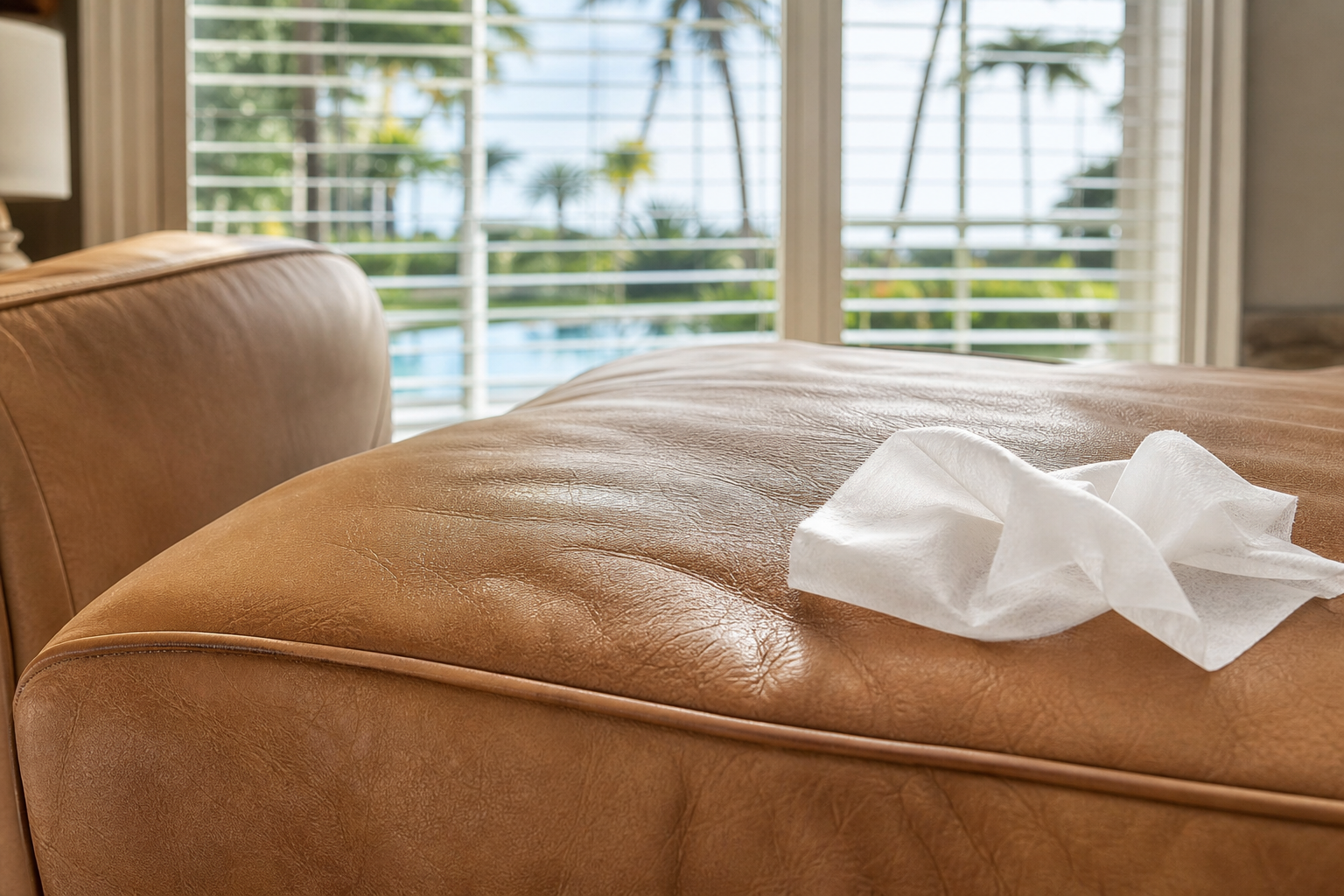
Baby wipes are convenient, gentle enough for many everyday uses, and easy to keep in a car, diaper bag, or living room. That convenience often leads people to use them on leather furniture, vehicle seats, handbags, and other leather surfaces. However, baby wipes are not designed to clean, condition, or protect leather.
Using a baby wipe once may not cause an obvious problem, especially on protected leather. Repeated use, however, can leave behind residues, spread contamination, disturb the finish, or contribute to changes in the leather’s appearance. These concerns are especially important in Southwest Florida, where heat, humidity, strong sunlight, sunscreen, body oils, and seasonal moisture can already place additional stress on leather.
This guide explains why baby wipes are a poor substitute for a leather cleaner, what to do if you have already used them, and when professional leather cleaning or restoration may be the better option.
Why baby wipes are not leather cleaners
Leather is a finished material rather than an ordinary washable surface. Depending on the item, it may have a protective coating, color layer, natural texture, or specialized finish that reacts differently to moisture and cleaning products. A product that is suitable for skin does not automatically work well on leather.
Baby wipes are formulated primarily for cleaning skin. Their ingredients can vary, but many contain water, preservatives, cleansing agents, emollients, fragrances, or other additives. Even wipes marketed as gentle or fragrance-free are not necessarily appropriate for leather.
They can leave residue behind
A baby wipe may remove a small amount of surface dirt, but it can also deposit ingredients onto the leather. Moisturizers, cleansing agents, and other residues may create a dull, hazy, sticky, or uneven appearance. Residue can also attract additional dust and soil, making the area look dirty again more quickly.
On frequently handled areas such as steering wheels, armrests, door panels, and sofa cushions, this buildup may become more noticeable over time. It can also make later professional cleaning more complicated because the technician must remove both the original soil and the products previously applied.
They provide uncontrolled moisture
Leather generally benefits from controlled, appropriate cleaning rather than repeated wet wiping. A baby wipe can introduce moisture unevenly, particularly when someone rubs the same spot several times. Excess moisture may move dirt into the grain or seams, create tide marks, or affect vulnerable areas such as perforations, piping, stitching, and unfinished edges.
Florida’s humidity can make drying more difficult. Leather that stays damp in a warm, poorly ventilated environment may develop an unpleasant odor or become more vulnerable to additional contamination. Moisture is especially concerning in boats, vehicles parked outdoors, enclosed lanais, and seasonal homes that are not consistently climate controlled.
They may affect the leather finish
Many leather surfaces have a protective topcoat that helps shield the color and underlying material. Repeated rubbing with an unsuitable product may leave that finish looking uneven or worn. On older, heavily used, corrected-grain, aniline, or specialty leather, the effect may be more visible.
Baby wipes are also not designed to replenish or protect a leather finish. Even when they make a surface appear temporarily cleaner, they do not replace a proper leather-care process.
What can happen when baby wipes are used repeatedly?
The result depends on the leather type, the condition of the finish, how often the wipes are used, and what contaminants are present. Possible signs of product-related problems include:
- A sticky or tacky feel
- A cloudy, greasy, or hazy appearance
- Uneven sheen between wiped and unwiped areas
- Darkened or discolored patches
- Dry-looking grain or a change in texture
- Soil that returns quickly after wiping
- Odor from trapped moisture or residue
- Color transfer or finish disturbance on vulnerable leather
These signs do not always mean the leather is permanently damaged. They do indicate that more wiping with the same product is unlikely to solve the problem. Aggressive scrubbing, household cleaners, alcohol-based products, disinfectants, or additional conditioning products may make the appearance worse.
Are baby wipes ever safe for leather?
It is best not to treat baby wipes as a routine leather-cleaning product. Some protected leather surfaces may tolerate occasional light contact without an immediate visible reaction, but tolerance is not the same as suitability. The absence of immediate damage does not confirm that the wipe is safe for repeated use.
If a baby wipe accidentally touches a leather surface, stop using it and allow the area to dry naturally. Do not continue rubbing simply because the surface still looks dirty. If necessary, blot gently with a clean, dry, absorbent cloth. Avoid heat from a hair dryer, direct sunlight, or placing the item near a strong vent to speed drying.
What should you use instead of baby wipes?
Use a leather-cleaning product selected for the specific type and finish of leather. The correct approach usually involves controlled application, a soft cloth or appropriate cleaning tool, and enough care to avoid over-wetting the surface.
Identify the leather before choosing a product
Leather furniture, automotive interiors, marine seating, handbags, and commercial furnishings may all use different finishes. Protected or pigmented leather has a surface coating that affects how it should be cleaned. Aniline, semi-aniline, nubuck, suede, and specialty finishes may require very different handling.
If you are unsure what type of leather you own, review the manufacturer’s care instructions or consult a professional before testing a product. Our guide to pigmented and protected leather explains why the finish matters when planning routine care.
Choose products made for leather care
A suitable leather cleaner should be intended for leather and appropriate for the item’s finish. Avoid assuming that a product is safe because it is labeled natural, gentle, moisturizing, plant-based, or suitable for household surfaces. Read the product directions and test it in a concealed area when the manufacturer recommends testing.
Cleaning and conditioning are also separate steps. A cleaner is intended to remove soil and residues; a conditioner may help maintain the feel and appearance of certain leather finishes when used appropriately. Applying conditioner to dirty leather can trap contamination or create an uneven appearance. Learn more in Why Leather Cleaning and Conditioning Are Two Different Steps.
A safer basic cleaning process for protected leather
For a small, recent surface mark on clearly identified protected leather, the following general process is more appropriate than using baby wipes:
- Remove loose dust with a soft, dry cloth or a suitable vacuum attachment.
- Check the manufacturer’s care guidance and identify the leather finish if possible.
- Test the leather cleaner in a hidden area and allow the test area to dry.
- Apply a small amount of the approved cleaner to a cloth or according to the product instructions rather than saturating the leather.
- Work gently over a manageable section, avoiding aggressive scrubbing.
- Use a separate clean cloth to remove loosened soil or excess product.
- Allow the surface to dry naturally and inspect it before applying any additional product.
This process is not appropriate for every leather type or every stain. Water marks, ink, dye transfer, food oils, pet contamination, mildew, and finish damage may require a more specialized treatment.
Southwest Florida considerations for leather care
Leather in Fort Myers, Cape Coral, Naples, Bonita Springs, Estero, Marco Island, Sanibel, Captiva, Lehigh Acres, Punta Gorda, Port Charlotte, and nearby communities can face conditions that make improper cleaning more noticeable.
- Heat: Hot interiors and rooms can accelerate the drying of surface oils and may make residue feel more noticeable.
- UV exposure: Sunlight can contribute to fading and finish changes, particularly near windows or in vehicles and boats.
- Humidity: Moisture in the air can slow drying and contribute to odor concerns when leather is repeatedly dampened.
- Sunscreen and body oils: These contaminants commonly accumulate on headrests, armrests, steering wheels, seats, and frequently touched furniture.
- Salt and coastal exposure: Salt residue can be abrasive and may affect surfaces if it is repeatedly wiped without proper cleaning.
- Seasonal properties: Closed homes, vehicles, and boats may develop concentrated dust, odors, or moisture-related contamination while unused.
For leather exposed to water or high humidity, avoid trying to even out the appearance by repeatedly wiping the entire surface. Our article on water spots and water damage on leather covers why moisture-related marks can be difficult to correct safely.
What to do if you have already used baby wipes
If you have used baby wipes on leather, do not panic and do not immediately apply another product to counteract it. First, stop using the wipes and check the surface in good light. Look for stickiness, streaking, color change, dullness, or areas that feel different from the surrounding leather.
For a minor application on a protected surface, gently blotting with a dry, clean cloth may remove some surface moisture. Avoid soaking the leather or repeatedly rubbing it. Do not use household soap, disinfectant, alcohol, vinegar, oils, or furniture polish unless the leather manufacturer specifically approves the product for that surface.
Professional evaluation is sensible when the leather is valuable, delicate, extensively discolored, sticky, cracked, heavily soiled, or exposed to pet contamination, saltwater, mold, or mildew. A professional can assess the finish and determine whether the issue is residue, contamination, color loss, finish wear, or a combination of problems.
When professional leather cleaning is the better choice
Professional leather care is particularly helpful when a surface has been cleaned repeatedly with unsuitable products or when the source of the discoloration is uncertain. An experienced technician can separate cleaning concerns from repair, redye, or restoration concerns and recommend a service based on the leather’s condition.
This may be appropriate for:
- Luxury sofas, chairs, and sectionals
- Automotive interiors and specialty vehicle seating
- Boat and yacht seating exposed to salt, sunscreen, and humidity
- Aircraft seating and interior leather
- Commercial, hospitality, and medical office furnishings
- Leather with embedded odor or contamination
- Surfaces with finish damage, fading, cracking, or color loss
Luxury Leather provides professional leather cleaning, conditioning, protection, repair, redye, and restoration services throughout Southwest Florida. The right service depends on the leather and the problem, not simply on the product that was used last.
Frequently asked questions
Can baby wipes remove a fresh spill from leather?
They may lift a small amount of surface material, but they can also spread the spill or leave residue. Blot a fresh spill gently with a clean, dry cloth and seek guidance if the substance is oily, strongly colored, or likely to stain.
Are fragrance-free baby wipes safer for leather?
Fragrance-free does not mean leather-safe. These wipes may still contain moisture, cleansing agents, preservatives, or emollients that are not intended for leather finishes.
Can baby wipes dry out leather?
Repeated wet wiping and rubbing can contribute to an uneven appearance or affect the surface finish. Baby wipes are not formulated to condition leather or maintain its finish.
What if my leather feels sticky after using baby wipes?
Stop applying additional products and avoid aggressive scrubbing. The stickiness may be caused by residue or a finish issue. A professional assessment can help determine the safest way to address it.
Can I use baby wipes on car leather in Southwest Florida?
They are not recommended as a routine cleaner for vehicle leather. Heat, sunscreen, body oils, humidity, and UV exposure can make residue and finish changes more apparent. Use a product approved for the vehicle’s specific leather or consult a professional.
Protect your leather with the right care
Baby wipes are useful for their intended purpose, but they are not a substitute for professional leather cleaning or a properly selected leather-care product. Using the wrong product repeatedly can leave residue, alter the appearance, and make contamination harder to remove.
If leather furniture, vehicle seating, boat upholstery, aircraft interiors, or commercial furnishings in Southwest Florida need attention, contact Luxury Leather for a free consultation. We can help evaluate the material and recommend an appropriate cleaning, conditioning, protection, repair, or restoration service.