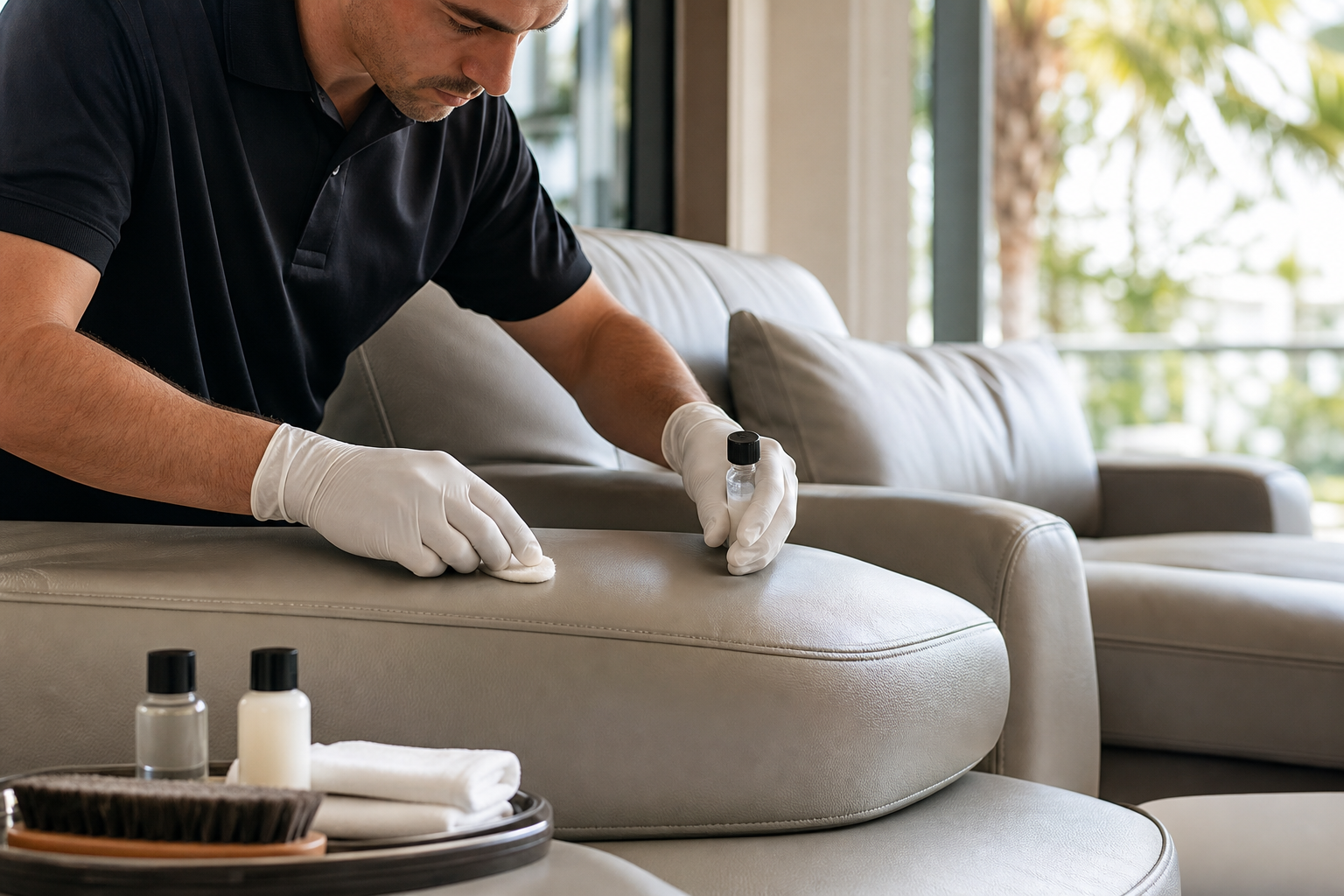
Professional leather cleaning should never begin with a cleaner applied at random. Before working on a sofa, automobile interior, boat seat, aircraft cabin, or commercial seating, an experienced technician first evaluates and tests the leather.
This step helps determine how the material, color, finish, and existing damage may respond to cleaning. It also allows the technician to select an appropriate process rather than relying on a one-size-fits-all product or assumption.
For leather owners in Fort Myers, Naples, Cape Coral, and throughout Southwest Florida, testing is especially important. Heat, humidity, ultraviolet exposure, sunscreen, perspiration, salt air, body oils, and seasonal-home conditions can all affect leather differently. A careful inspection and test provide the foundation for responsible cleaning and preservation.
What Leather Testing Means Before Cleaning
Leather testing is a controlled evaluation performed before the main cleaning process. A technician examines the material and applies a small amount of the intended product or method in an inconspicuous area, observing how the leather responds.
The goal is not simply to see whether dirt comes off. Testing can help identify whether the leather:
- Releases color when lightly cleaned
- Absorbs moisture quickly or remains relatively sealed
- Has a stable or deteriorating protective finish
- Shows signs of previous dye work, repair, or coating
- Contains damage that cleaning could make more visible
- Requires a gentler, more specialized, or restoration-focused approach
Testing does not eliminate every possible risk, but it gives the technician useful information before treating the visible surface.
Why Leather Cannot Be Cleaned the Same Way Every Time
“Leather” describes a broad range of materials rather than one uniform surface. Different hides, finishes, colors, coatings, and manufacturing processes can respond differently to moisture, agitation, and cleaning solutions.
Finished and pigmented leather
Many residential and automotive leather surfaces have a color layer and protective finish over the hide. These surfaces may tolerate appropriate cleaning well, but the finish can still be worn, brittle, sticky, scratched, or partially missing.
A cleaner that is suitable for a stable finish may not be appropriate for an area where the coating has weakened. Testing helps reveal whether the surface is still protecting the underlying leather.
Aniline and other more absorbent leather
Some leather has a more open, natural surface that can absorb moisture and cleaning products more readily. These materials may show variation, darkening, or changes in appearance if treated too aggressively.
Absorbent leather often requires careful control of product quantity, moisture, dwell time, and agitation. A preliminary test helps identify how the surface behaves before a larger area is treated.
Corrected, coated, or previously refinished leather
A piece may have been refinished, recolored, repaired, or treated with a protective coating during its life. Previous work can affect how new products interact with the surface.
Testing may help identify an unstable color layer, inconsistent coating, or areas that need repair or color restoration before conventional cleaning is attempted.
What We Look for During a Leather Assessment
Testing is only one part of the preparation process. A professional assessment considers the leather’s overall condition, use, environment, and history.
Surface finish and coating condition
The finish is the outer protective layer on many leather items. It influences how the material handles moisture, oils, abrasion, and cleaning. A worn or damaged finish may look dull, feel tacky, or show uneven color.
If the finish is compromised, cleaning alone may not address the underlying problem. The appropriate next step could involve conditioning, protective treatment, repair, redye work, or finish restoration.
For more information about the role of a protective coating, read Protective Topcoats for Leather: What They Do and When You Need One.
Colorfastness
Colorfastness refers to how well the leather’s color remains stable during cleaning and normal use. A cloth or applicator that picks up color may indicate that the surface needs additional caution.
Color transfer can occur for several reasons, including the type of dye, wear to the finish, previous color work, or chemical breakdown. If color movement is observed, the technician may adjust the process or recommend restoration rather than continuing with standard cleaning.
Absorbency
Some leather surfaces repel moisture, while others darken or absorb it quickly. Absorbency can vary across a single item, particularly where the finish has worn on frequently used areas such as seat bolsters, armrests, steering wheels, and cushion fronts.
Understanding absorbency helps the technician control moisture and reduce the chance of uneven appearance or over-wetting.
Existing damage
Cleaning may expose damage that was already present but hidden beneath soil, body oils, or a dull surface film. Cracking, abrasion, peeling, flaking, cuts, dye loss, and weakened seams should be identified before work begins.
Cleaning cannot reverse every type of deterioration. If the leather is already fragile, aggressive scrubbing may worsen the appearance. A careful technician documents the condition and explains what cleaning can and cannot accomplish.
What Can Happen When Leather Is Not Tested
Skipping a test can lead to an unsuitable cleaning method being used on the wrong surface. Possible problems include:
- Color transfer onto the cleaning cloth
- Uneven darkening on absorbent areas
- Streaking or visible changes in sheen
- Softening or lifting of a failing finish
- Greater visibility of scratches, abrasion, or dye loss
- Residue left behind by an incompatible product
- Additional drying or brittleness on already stressed leather
These outcomes are not inevitable, but they illustrate why professional cleaning should begin with evaluation rather than immediate application.
Household products can create additional uncertainty. All-purpose cleaners, disinfectants, degreasers, oils, and fragranced products may contain ingredients that are unsuitable for a leather finish. Our guide on why the wrong leather cleaner can damage the finish first explains why the outer coating deserves particular attention.
How Testing Guides the Cleaning Process
Once the leather has been evaluated, the technician can make more informed decisions about the service.
Choosing the cleaning approach
The test may help determine whether the surface is suitable for a standard professional cleaning process or whether a more conservative method is necessary. It can also indicate where separate techniques may be needed on different sections of the same item.
Controlling moisture and agitation
Leather cleaning is not simply a matter of applying more product or scrubbing harder. The amount of moisture and level of agitation should be appropriate for the surface condition. Worn areas may require lighter handling than stable, heavily finished sections.
Separating cleaning from restoration
A test can show that the main issue is not removable soil but finish wear, dye loss, cracking, or another form of damage. In that situation, cleaning may still be useful, but it should be presented as one part of a larger restoration plan.
For example, a worn leather chair may look dirty because the finish has become uneven. Removing surface soil will not recreate missing color or rebuild a damaged coating. That may require leather repair, redye, or finish restoration after the surface is properly prepared.
Why Southwest Florida Conditions Make Testing Especially Valuable
Leather in Southwest Florida often experiences a demanding environment. Homes and vehicles may be exposed to strong sunlight, high temperatures, humidity, sand, sunscreen, perspiration, and frequent indoor-outdoor transitions.
Coastal properties in Naples, Bonita Springs, Marco Island, Sanibel, Captiva, Fort Myers, and nearby communities may also encounter salt-laden air and moisture conditions that affect both leather and its protective finish. Boats and marine seating face even more direct exposure to water, sunscreen, and heat.
Seasonal properties present another consideration. A leather sofa or vehicle interior may remain unused for extended periods, then receive heavy use during a visit. Limited ventilation, closed interiors, and humidity can contribute to odors, surface contamination, or mildew concerns.
These conditions do not mean every item needs the same service. They do mean a visual inspection and test are valuable before selecting a cleaning or protection method. If you are concerned about visible growth or musty odors, review our guide to mold and mildew on leather in Southwest Florida.
What a Professional Leather Cleaning Consultation Should Include
When comparing leather care providers, look for a process that includes more than a quick product application. A professional consultation should address:
- The type and apparent finish of the leather
- The item’s age, use, and environment
- Visible stains, contamination, and odor concerns
- Cracking, peeling, abrasion, or color loss
- Previous cleaning, repair, dye, or coating work
- The intended cleaning method and any limitations
- Whether conditioning, protection, repair, or restoration may also be appropriate
It is reasonable to ask where testing will be performed, what the technician is observing, and whether the proposed service is intended to clean, restore, protect, or address more than one concern. Clear expectations are an important part of caring for valuable leather.
Does Testing Delay the Cleaning Service?
Testing is a preparation step, not an unnecessary delay. The time required depends on the size and type of the item, its condition, the number of materials involved, and the concerns identified during inspection.
For a leather sofa, the technician may assess multiple high-use areas. For an automobile, boat, or aircraft interior, different panels may have different levels of wear and exposure. Taking time to understand those differences supports a more controlled service.
Frequently Asked Questions
Does every leather item need to be tested before cleaning?
Professional testing is a prudent part of evaluating leather before cleaning, particularly when the material is valuable, heavily soiled, previously treated, damaged, or unfamiliar. The extent of testing depends on the item and its condition.
Can testing tell whether a stain will come out?
Testing can provide information about how the surface responds to cleaning, but it cannot guarantee that a stain will be removed. Some marks have permanently altered the finish or color, while others may be contamination that requires a specialized approach.
Will testing damage the hidden area?
A professional test is performed in a discreet location using a controlled amount of the selected product or method. The purpose is to gather information while limiting unnecessary exposure. The technician should explain any concerns before proceeding.
Why did my leather change color when I cleaned it at home?
Color change can result from dye transfer, finish wear, excessive moisture, incompatible products, or revealing damage that was previously hidden by surface soil. The specific cause requires an assessment of the leather and the product used.
Is testing needed for leather seats in cars and boats?
Yes. Automotive and marine leather may experience sunscreen, perspiration, salt, UV exposure, heat, and frequent friction. Testing can help determine how worn or exposed areas should be handled.
Professional Leather Testing in Southwest Florida
Testing before cleaning reflects a preservation-first approach. It helps Luxury Leather understand the material, identify risks, choose an appropriate process, and set realistic expectations before work begins.
Whether you need care for residential furniture, an automotive interior, marine seating, an aircraft cabin, or commercial leather furnishings, our team serves Southwest Florida communities including Fort Myers, Cape Coral, Naples, Bonita Springs, Estero, Marco Island, Sanibel, Captiva, Lehigh Acres, Punta Gorda, Port Charlotte, and surrounding areas.
Contact Luxury Leather for a free consultation and a professional evaluation of your leather cleaning, protection, repair, or restoration needs.